Sunday, August 29, 2021

61 Years Ago Nursing in Switzerland

In September of 1959 two of my nursing  Psychiatric Nursing colleagues, Marion Bronsch and Jacqui Dutruit and I travelled to England to work for 6 months, in Belmont Hospital Sutton, Surrey. During the next six months that followed we hitch-hike throughout Europe and by August 1960 we ran out of money so had to find  work in order to return to Canada. 

Lorraine,  Marion, Jacqui 

Fortunately, we were able to find hospitals that accepted our nursing degree. Jacqui in “Hopital de Cery”,  Lausanne,  while Marion and I in a small hospital located between Lausanne and Geneva, Switzerland.  Here is it's  history which is still in operation today: 


Quotes from  “Notes and Clippings-It all started in Saskatchewan”, autobiography, 

Page 131“Institution Lavigny In 1905, shocked by the tragic death of a young epileptic, Charles Subilia, Minister of National Waldensian Church, laid before his colleagues at the Conference of Cantonal ministers a report on the public assistance Vaud in which he advocates creation of an "asylum for the sick can not be allowed in the current charitable institutions and especially people with epilepsy." In September 1906 consists in the Hôtel de Ville de Lausanne "the Company in favour of epilepsy", which is the acquisition of a property in the village of Lavigny. In 1907 there was opened a shelter that welcomes minors sixteen residents. The Institution Lavigny was born, and with it the assumption by the company of people with epilepsy in respect of moral values footprints of any religious philosophy of the new century: the love of neighbour, self-sacrifice, family spirit”

Page 131 “Because of the language barrier (French/English) and our short time there (2months),  Dr. Tchicaloff hired Marion and I as nurses aids.  Our wages would be 50 SF a month, ($50.00). We would be working twelve hour shifts, seven in the morning to seven in the evening, with two hours off at noon and tea breaks. For our first month we got one days off a week. There was no sick time. If we were not able to work due illness the day-off would be used”
Lorraine Christmas 1960 

Page 133 “By the end of October we had made our minds up. Marion and I talked it over with Jacqui and we decided we would like to work until spring. When we told Dr. Tchicaloff  of our decision he raised our wages to 550 SF a month. I felt much better for staying another four months and earning more money. Now we were encouraged to take French lessons.”

Page 136 (From Letter of Recommendation) 
“I, the  unassigned, Dr. Michel Tchicaloff, Medical Director of the Institution of Lavigny certified that Miss Lorraine Bertrand worked  as nurse since the September 5, 1960 with  satisfaction. Her work  in particularly with  the various problems posed by patients with epilepsy. We  regret to see her leave and want all our best for the continuation of her career.”  

Today the three of us remember those time together with nostalgia.

Tuesday, April 13, 2021

Gallivan My Home Town


Quote from Notes and Clippings, It all Started in Saskatchewan and Autobiography 

by Lorraine (Bertrand/Birstein) Martin 2017  

Chapter One The Gallivan Years Page 28 

Gallivan My Home Town

  (Published in the Western Producer during the 1950s )

Dear Co-op- I want to tell you about my home town. In Gallivan there are only a few buildings. There are two store and in one store there is a post office. The owner of this store also runs a work shop, a sort of garage. The community hall is used for a high school. The public school is in a different room altogether. Our school takes grades one to six, the other grades seven to eleven. There is also a United Church and a manse. There is a C.N.R Station, a Pool elevator. A few men work on the section and fix the railway. Around the district there are many farmers. The history of Gallivan is a very interesting one. In 1903 the first man to make a settlement in this district was Mr. Mike Gallivan. Mr. Gallivan came from Ontario to Saskatchewan in 1903 to seek a new home. Choosing the land, now where Gallivan stands, he cleared and broke the soil on which he planted trees because there weren't any but small scrubby poplars. He built a home and ran a blacksmith's shop, which still stands. The home also stands but is remodelled. When the settlement was young, there were no store, or good roads, railway, elevators, schools or churches. The railway was built in 1912, elevators in about 1913, school in about 1917, hall in 1940 and there were telephones put in homes. The nearest town was North Battleford. Now, Mr. Gallivan is a resident of Cut Knife, which not far from the hamlet, which bears his name. ---------- “Frenchie” Gallivan Sask. ("Frenchie" was my pen name at the time) 


Thursday, January 28, 2021

Tasks Needed to Compile and Publish Book

In a recent Human's Being More Online Class the assignment was to make a list  of  "Tiny Tasks"  to complete a goal or habit.  

"Tiny tasks are the actions you end up with when you break a goal or habit down into the smallest component parts that are necessary for accomplishing the goal or habit. What are the tiny tasks needed to accomplish your goal or habit? What is the system or process for allowing the goal or habit to be enacted and completed?"

I choose the following tasks for a goal on how I published my story. 

1.  Back in 2010, I conceived the desire to write my story.I visualized the steps,ie: the content, research, compiling material. 

2.  In a special containers I collected my material, pictures, journals, diaries, records that I had on hand and saved. 

3. I set up a schedule on my calendar to work on my story production and I identify the best time of day to get started without distractions. I found early mornings worked best for me as I got inspired just as I woke up and before I got out of bed. After good nights sleep and I felt well rested and was able to focus on the tasks.

4. Made my work area /office as comfortable as possible good lighting, clean air and container of water.

5. Organized supplies I needed ie: pens, pencils, paper, markers, envelops, file folders, sticky notes, waster paper basket, computer/typewriter, phone.

6. I sorted out all the necessary material in the order I decided where it was to appear in my story.

7. I typed out all my journals/diaries on the computer.

8. Pictures: tell stories, create memories and recollections on past events. I scanned older pictures onto the computer in to dated files and wrote down my memories and identified the people, year and occasion. 

 9. I reviewed my wrote daily to edit the content and make the necessary changes. 

10. I made trips to researched in the archives of community newspapers that reported my participation in events. Fortunately I had saved many clippings. 

11. I scanned all these reports and clippings on the computer and placed in dated files. 

12. Genealogy research was given from many family members who so thoughtfully  had recorded theirs. I contacted them for permission the used their material. 

13.  The content table was a guide to work from. I researched other books for reference. I created a page to record where I got references. This included - unpublished family stories, newspapers, historical community publications and online sites. 

14.  I took a workshop on writing for what is called “A Vanity Book” (where you can say and do what you want.) 

15.  I took my time with a comfortable date of completion. 

16.  I wrote daily when things came to mind. 

17.  Once I chose an editor and publisher (Studioeh Designs- owner, my husband) I worked closely with him. Every step was a new learning curve and was exciting to see it coming together. He worked in his favourite computer picture and document editing programs. 

18.With the advise of my editor I selected  a Publisher - Kettle Valley Graphics, Kelowna, BC.

19  Proof reading: I asked others to proof read my text and suggest changes. 

20. Applied for a ISBN number. A self published finished book was the reward of four years of work.

 21.  Book Launched: I planned dates and places to do a book launch with family,  communities in which my story took place and libraries. 

Osoyoos Library 

North Battleford Library 

Signing with family, BC 


From what I learned writing my story I am now working on my mother's story. “Hughenna’s Story”. 

Tuesday, January 12, 2021

Lorna (Buglas) Gaudet Memories

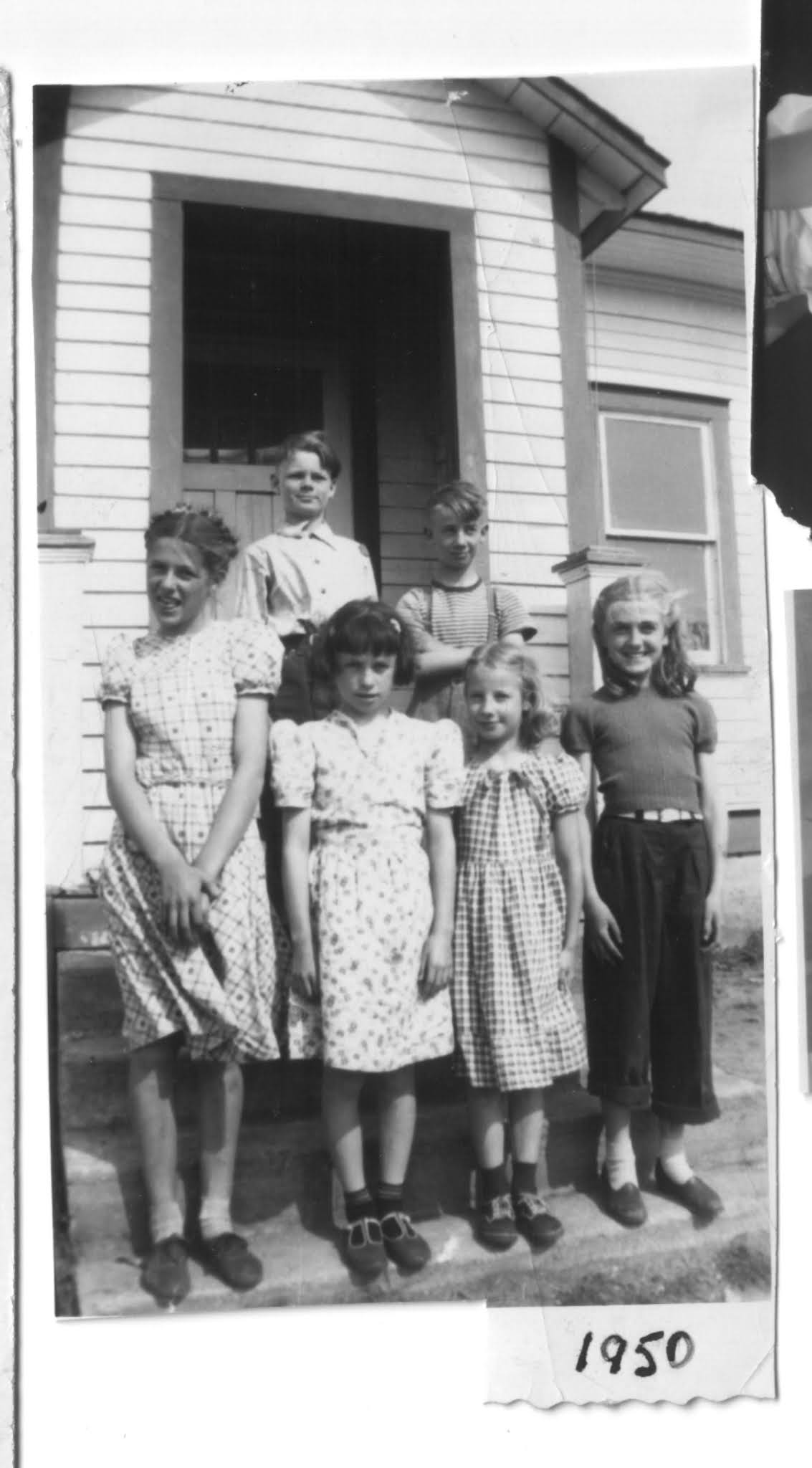
I have the pleasure to connect to a girl friend from early Gallivan School Days, dating back to 1950's. I asked her to write her memories of those days. 70 years has gone of grades 5 and 6 at Gallivan Public School. 
Back row- Arnie Anderson, Clifford Laing
 Front row- Lorraine Bertrand, Lorna Buglas, Gail Laing, Elaine Scott 

From Lorna ( Buglas) Gaudet (January 11, 2021)

In July, 1950, Jim and Mary Buglas and their children: Connie, Fred, Lorna, and Kathleen moved to an almost hamlet of Gallivan, Saskatchewan. It was not a promising move: filthy house, no electricity, weed (mostly tansy) choked garden and yard, and two grain elevators: Pool red “B” storage elevator (plugged full of spoiled barley) and grey metal-sheeted “A”, supposedly clean and ready for operation. It turned out that the clean referred to all the office furniture that had been cleaned out by the previous agent, who had also been hired to make the Pool house’s attached garage into a kitchen. He and a crony did so using a few bags of wood shavings and a hundred small pieces of drywall—larger sheets having somehow got sidetracked to a private project back in his homebase of Wilkie.

The Buglases had moved from a newly refurbished electrified Pool cottage with a changed roofstyle, an extra bedroom, an enlarged cellar (almost a basement!), their much-loved home in the Village of Adanac, near Unity. We were moving from a tidy place where Jim had one grain elevator to operate for the Sask Wheat Pool among friendly rival buyers for the Searle, Reliance, and United Grain Growers. The Village had a general store and post office, regular daily train service (on the second most important CPR line across Saskatchewan), a lumberyard, a livery barn, a hardware and vehicle repair service, a hotel, with ice-cream parlor, a skating rink with permanent boards and changing house, an elementary school, a town hall, wooden sidewalks, two churches with rectories (Anglican and United), assorted houses, two farms on opposite sides of town. But no highschool.

Gallivan had a CNR branch line stationhouse used as a “section house” (inhabited by the Section Foreman (section men kept the track in shape by daily patrols and hard work in all weathers, patrolling from their speeder—noisy gas-engine fueled and fumed open vehicle). Gallivan had two stores, one with post office and garage vehicle repair. Both had gas pumps and fuel delivery services. There was one farm at the north edge of the hamlet, a United Church with manse (rented out), two schools (the hamlet hall doubled as the highschool), four other dwellings. The hamlet water sources appeared to be the Cut Knife Creek, curling its way around the hamlet and a few farms, and the store\post office’s drilled and handpumped well.

The Buglases soon adapted to the friendly people in and around Gallivan. A lot of hard work and Jim’s carpentry skills began to furnish the elevator office, added our Adanac “playhouse—guest bedroom” hauled by truck from Adanac (built from Buglas-bought lumber, not Pool-owned) but tacked as a leanto on the northside of the Pool cottage. Very soon, with the start of school, the Buglases met their classmates as friends.

Early in September, Lorna’s Grade VI classmate, Lorraine Bertrand brought a supper invitation for Lorna and Kay to join the family of Ovide and Hughenna at their farm a short half-mile from Gallivan. It was a momentous occasion for us. Their home had the most wonderful barn with two gleaming silver cupolas, a wonderful garden-orchard, electricity, water, and a dear welcoming family. Ovide (farmer-electrician) charmed us forever by telling shy us that he charged a nickel to all guests passing him to slide onto the bench seat in back of the long table, and Hughenna won our hearts with her kind words and delicious meal.

As that school year went on, Lorna discovered that she and Hughenna were READERS with very similar tastes. Hughenna lent Lorna her bookclub copy of T.H. White’s lovely novel “Mistress Masham’s

Repose”, published in 1946 . It was magic—a long-past its glory days eighteenth century palace Malplaquet in rural England with a manmade lake and a Greek Temple inhabited by a kidnapped colony of Lilliputians. The Palace is the home of ten-year-old Maria, an orphan and her wicked governess Miss Brown, and so the adventure begins. Dad and I both loved that book and others Hughenna lent us. In my twenties I found a copy of White’s book in a Saskatoon used book store, bought it, and have reread it every two or so years since. That childhood magic happiness returns.

Another Mrs. B. moment came the fall I was twelve. Kay and I had gone home with the Bertrand family from our two schools. During the summer the hall had been moved from behind the United Church to a wonderful basement, engineered by Bob and son Clayton Mclain. They built cement foundations like they should be built. Of course, the many bystanders, of those summer days had lots of advice. But for vandalism and neglect on the part of us who loved that dear hall/school/basement, it would be standing still.

Back to the story, Lorraine and I were in Grade VII (high school now) and Arthur and Kay were in Grade V, with David in Grade I at the elementary school. When we reached the farm, Kay was recruited to help with the afterschool chores, while Mrs. B. appeared with two lidded metal pails (lard pails, I think). She handed one to me and said, “You come with me.” We went to the orchard-garden and sand(choke)cherry tree. We picked sand (choke)cherries and talked until our pails were full of ripe dark purple fruit. We talked books and life. She wanted me to promise her that I would let nothing stand in my way of going to University and becoming a writer. If only-- The pail of cherries I picked Mrs. B. sent home to Mom who very gratefully made jam and returned the pail via Lorraine and Art to their mother. Of course, my mother, another good cook had filled it with cookies or possibly date squares (also known as matrimonial cake).

For years after that, Mrs. B. and I exchanged books and information on them (what was good in the Sask Wheat Pool travelling library (a cooperative program with the Provincial Library) or book clubs. Through Lorraine’s wonderful Memoir, I can relive my treasured friendship with Hughenna B.


Saturday, October 3, 2020

Cut Knife Courier Ends

I wish to express my sadness that the Cut Knife Courier has been discontinued. The efforts Ray and Andrea Stewart have put into it over the past few years has been phenomenal. They should feel proud that they were able to contribute to everyone's lives as well as the Cut Knife Community. 

Although, I had not subscribed for the paper  for many years, I really appreciated these past years of receiving it online.  

I can not say enough about the value of a local newspaper, to the individuals, the province and the country. It has recorded  history in the making. For this alone is very important. The content of the stories were very personal which make the reader feel proud to get positive knowledge at the grass roots. 

For myself, what I have taken away was personal growth from the events that I was involved with during my early years when I lived in the Cut Knife area. It truly has left a mark on me over the years. I know all the individuals whom Ray and Andrea Stewart wrote about will feel the same. It had given us strength and moulded us to what we are today. Everyone of these stories have been interesting and heartfelt. 

If it had  not been for the Courier I would not have the courage to write my story in Notes and Clippings, It all Started In Saskatchewan.Those early reports I clipped out and have saved. I brings much joy to read them today. 


Sunday, June 14, 2020

60 Years Ago Today

60 years ago today, June 14 1960, I was hiking through Switzerland.  Back in my early 20's I was on an adventure of  a life time hiking though Europe with two friends, Marion and Jacqui. We had become friends during our training as  Saskatchewan Psychiatric Nurses.  After graduation  we sailed to  England to work for  six months  in a hospital in  Sutton, Surrey

We  had just arrived in Switzerland, after hiking through France, Spain, Portugal and Austria,  We had been on the road since mid April. While in Switzerland we visited Jacqui’s family. Our mail from back home was waiting for us. It felt good to relax, have a bath, wash our clothes, and get our hair cut. 

Here is what I wrote in my Journal:   June 14, 1960 


“Woke early, had breakfast and at 9:00 am Jacqui's uncle took us to see the UN Building, making the 9:30 am tour. We were in awe with the beautiful modern rooms made of marble, brass and walnut wood. We went to the Assembly Room and sat in on the National World Committee meeting for a few minutes, listened through ear phones to the interpreter. The summer Conference of 1955 was held there. The pictures in this room were painted by a Spanish painter from San Sebastian, Spain.We walked around the grounds then went up to Library. Jacqui's cousin, Claude, worked at the UN Building so we met him for a short visit in the large beautiful Library. After our tour Uncle George took us back to his place for lunch. After lunch we went over to visit Jacqui’s cousins, Before supper Marion and I went to buy a gift for them. After supper we were taken to another cousin . We looked at pictures of our adventures. When is got dark to see lights of city reflecting on lake, beautiful. Home by midnight and spent the night.”

Visiting Jacqui's cousins 

Wednesday, October 30, 2019

Small Town Saskatchewan Newspaper.

The small town newspaper of the Highway 40 Courier, now known as The Courier,  was very important source of material that contributed to writing, Notes and Clippings- it all started in Saskatchewan. 

Over the years during 1940 and 1950 I clipped and saved articles that was of interest to me, thus my story. My last clipping was when I was doing a book reading at the Cut Knife Senior Centre in 2018.


On October 27, 2019 Global News published an article 

How a small-town Saskatchewan newspaper is surviving in a changing industry  by  BY NATHANIEL DOVE Posted October 27, 2019 7:43 pm updated October 28, 2019 4:25 am

Thanks to the Cut Knife  Courier editor, Ray Stewart,  for making this "small town newspaper" so interesting to it's many readers who resides elsewhere. 

Copies of Notes and Clippings are still available by contacting Lorraine Martin. lorrainemartin831@gmail.com 


Sunday, March 3, 2019

Psychiatric Nurse Training

Excerpts from Notes and Clippings. 

"In April, 1956, I applied for the psychiatric nursing training course at the Saskatchewan Hospital and began my training in September."

"Student Psychiatric Nurses I, II, III, receive salaries of $169.00, $198.00 and $218.00 per month respectively." 


My Mother and Father Hughenna and Ovide Bertrand 

"I was with a group of several other timid young people being orientated that first day. We were fitted for uniforms; given a set of keys; shown through several departments and wards. I questioned then as to what I was getting myself into."

"Learning to give my first intramuscular injection (IM) was during those first months of employment. We were taught in the classroom to give injections using oranges. The treatments prescribed by the doctors during my training were Electra-Convulsive Therapy (ECT); Insulin Shock Therapy; Anti-Psychotic Drug Therapy and Seclusion. Recreational and Occupational Therapy was organised by the nursing staff."

"Three of seven children of Bertrand family graduated from the Psychiatric Nursing Program, Evelyn, Arthur and myself. Arthur's wife, Marlene, also graduated.  We renewed memories at the 80th Anniversary of the Saskatchewan Hospital, North Battleford in 1993".

Evelyn, Marlene, Arthur and I 
 The 100th Anniversary was held in July, 2013.

Former Ward Supervisor, Dorothy Mills and I 
''The history of the hospital dates back to 1912 when it was built on one of the most beautiful stretches of the North Saskatchewan River. At the time it was intended to accommodate eight hundred patients and was one of the most-up-to-date mental hospitals of the day."


The North Battleford Psychiatric Hospital had been closed and a new Psychiatric Forensic Hospital has replaced it. It was built this past year on the same grounds over looking the Saskatchewan River. The grand opening is in March 2019.

Old SHNB

New SHNB 

Monday, July 2, 2018

Saturday, June 16, 2018

Book Reading at The Osoyoos Library

I recently did a book reading of my autobiography "Notes and Clippings" at the Osoyoos Library. 


The Librarian did the introduction 


I had an hour to do the reading and presentation.


I appreciated this opportunity to tell my story. 

Monday, June 4, 2018

The Book Launch Continued.


On the Book Launch trip to Saskatchewan I donated a copy to the Libraries in North Battleford, Regina and Beth Jacob Synagogue.

North Battleford Library 

While in Regina I had a very nice visit with a Psychiatric Nursing colleague. 

Quote: from "Notes and Clippings- It all started in Saskatchewan" 
"Another Psychiatric Nurse, whom I worked with during that time, was Vera LaFayette. She was a member of Sonshine Christian Ministries. She works with Healing Through Prayer. While Vera and I worked together in the Activity Therapy Department she asked me to attend a session. I remember how uneasy I felt at the time as I was close-minded about sharing my prayers openly with anyone let alone within a therapeutic setting. The session and the words she spoke left me with a lasting impression."

Lorraine with Vera

Book Launch in Cut Knife SK

On the way from Osoyoos BC to Cut Knife in May my husband, Randal, and I were asked to stop in Marsden, SK to visit Connie (Buglas) Lane. She had a lot of memories of the Gallivan School Days to share. Thank you Connie for your stories.  
Connie (Buglas) Lane and Lorraine
 In Cut Knife Saskatchewan I held a book launch at the Senior Centre. It was exhilarating to see a Gallivan School class-mate from grade 6 to 10, Lorna Buglas.

Quote from "Notes And Clippings   "During these school years I was always comparing myself to others, constantly putting myself  down. I expressed this in my journal: 'Lorna is twice as smart as I am. She can read things once and remember what she reads, while I would have to read things several times before it sticks in my memory'.

Lorna (Buglas) Gaudet and Lorraine
While there I donated a copy to the Cut Knife Library. 


This write-up in the Cut Knife Courier was appreciated. Thank you for sharing it with your readers. 


Copies of  "Note and Clippings- It started in Saskatchewan" will be available 
at the Clayton Mclean Heritage Museum 

Wednesday, March 28, 2018

Phones

Telephones have come a long way!!  My parents had one of these telephone.

Quot from Chapter One- 'Gallivan Years"  
A wooden cased crank-style telephone hung on the wall. Our number was one long ring and two short ones. It was easy to 'rubber-neck' (listen) in on our neighbour's calls. The trick was to lift the receiver very carefully and place a finger in a special position in the receiver cradle. That way the people could not hear any noise and breathing from the listener. 


This picture was taken in the farm house kitchen during the 1950's. It shows the wood burning stove with  a "sad" iron sitting on the top. There was a "warming oven" on top of the stove and a "hot water reservoir" at far end. 

My mother sitting with her back to the camera, Aunt Elsie and my sister Evelyn. On the wall was the telephone of the day. 

Ciria 1950 Evelyn, Aunt Elsie Bertrand and Hughenna Bertrand  
 Now I am a "techy" using a cell phone, a computer and learning to communicate over the internet with ZOOM.